

 ENQUIRE NOW

"*" indicates required fields
ENQUIRE NOW
"*" indicates required fields
Designing and deploying systems for hospitality groups, entertainment venues and experience-led businesses, Pushcast delivers integrated venue technology including guest ordering, digital signage as well as the systems required for day-to-day operations. Working alongside venue operators and experience designers Pushcast takes technology from concept to reality – specifying, integrating and deploying systems that become an invisible and reliable element of how a business operates.
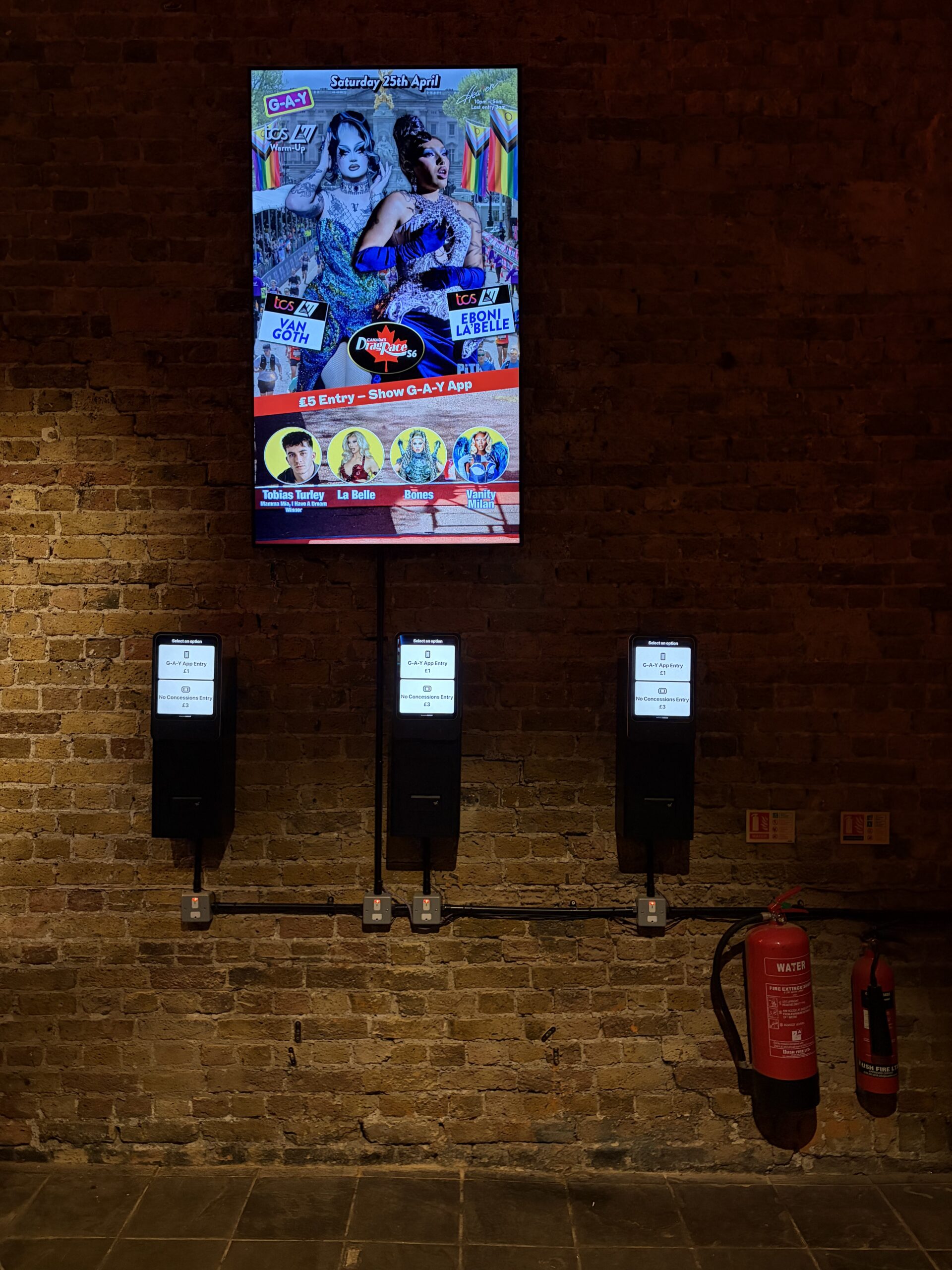
Pushcast developed its self-service admission and ticketing system initially for Heaven, a large nightclub in Central London. Six self-service kiosks are currently installed at the venue, allowing customers to pay for admission at the kiosk before receiving a small thermal ticket stub for entry.
A challenging operating environment
Presenting some unusual challenges, the system handles thousands of admission transactions on the busiest nights, with much of the traffic concentrated into only a few hours. Reliability and speed are therefore extremely important: printing needs to happen consistently and quickly without becoming a bottleneck in the admission process. Moreover, given the venue’s entrance is underground, Pushcast had to avoid the customer’s admission relying on mobile/network connectivity.
Although Pushcast was initially keen to implement a fully digital system, it decided that a simple physical ticket is the most robust solution. Being immediate and universally understood, physical tickets do not depend on the reliability of the customer’s phone or connectivity and can simply be handed to the admission staff.
Each kiosk uses an iPad running Pushcast’s admission and ticketing software, remotely managed by Pushcast, with an integrated payment terminal supporting contactless and chip payments. The iPad and payment hardware is mounted as part of an Ergonomic Solutions SpacePole Mini Kiosk enclosure with a Star mC-Print3 printer installed internally. The printer produces the ticket stub containing the information required for admission.
Star mC-Print3 and CloudPRNT™ technology
The compact footprint of the Star mC-Print3 makes it particularly well suited to integration within the kiosk enclosure, while its physical design, straightforward paper loading and resistance to liquid ingress are reassuring characteristics for a demanding nightclub environment.
According to Pushcast, Star CloudPRNT technology was another important factor. As the company runs its own software on the kiosks, Pushcast required an interface it could integrate directly rather than depending on printer-specific drivers or proprietary communication protocols. Pushcast’s previous experience with CloudPRNT also meant it could reuse an established and proven implementation, which was particularly useful given the extremely short project timescale.
Star CloudPRNT technology is used slightly differently from a traditional cloud-printing architecture. Rather than each printer communicating with a remote server over the internet, the CloudPRNT endpoints run locally on the same network as the printers. As a result, in the Heaven deployment each Star mC-Print3 printer communicates directly with a CloudPRNT web server running locally on its associated iPad.
As Michael McNeela, Founder, Pushcast explains: “This delivers a simple point-to-point architecture and keeps the printing path local, while allowing us to build the integration using simple, well-established web technologies rather than requiring printer-specific drivers or proprietary printing protocols. From our perspective as a software developer, this is one of the particularly useful aspects of CloudPRNT: the same protocol can work with a conventional internet-based architecture or, as in this deployment, with a deliberately local architecture.”
“We already had several years of experience using Star printers within other Pushcast deployments and had found the hardware dependable, so for this project Star was an obvious choice. Our experience with Star’s UK team was also a factor in choosing Star again. During our earlier deployments we encountered an unusual technical issue and Star helped us engage with the appropriate engineering expertise and work towards a resolution. Having accessible technical support in our own market, should we need it, gives us additional confidence when standardising hardware across customer deployments”, adds Michael McNeela.
A successful project delivered within weeks
From the initial brief for replacing the nightclub’s existing admission sales process with self-service kiosks to the system going live, the entire project was delivered within an exceptionally compressed timeframe of just two and a half weeks including an Easter bank holiday weekend.
As Michael McNeela concludes: “For us, one of the best measures of the printers’ success is simply that printing isn’t something we have to think about. In such a high-throughput workflow, a printer that intermittently fails or requires frequent intervention would very quickly become an operational problem. The Star mC-Print3 units have proven dependable, paper is quick for venue staff to replenish and the compact integration means the printer effectively disappears into the kiosk from the customer’s perspective.”
Need product support or help with integration? Contact the Star team today and they will be happy to help!